UPDATE Oct. 2012: We’re happy to report our first four Zili Dlo solar mothers left to go study in India at Barefoot College on Sept. 29, 2012 to become the first Barefoot college solar engineers from Haiti. See our preliminary photos at:1. Zili Dlo: 2012 -Solar power and clean water for Haiti , and at 2. Fon Batis mountain hamlet, Arcahaie, Haiti. Subscribe to our Newsletter, check this website or follow Ezili Dantò on Twitter and Facebook to follow their journey.
Zili Dlo: Solar engineers for Haiti
April 20, 2012 by Ezili Dantò for HLLN

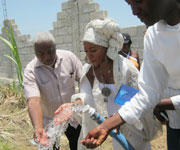
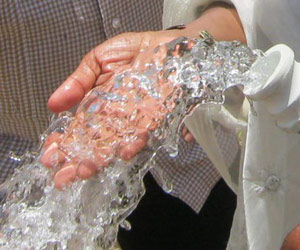
Photos of the Zili Dlo project on the EziliNetwork, our FB pages, Flickr and on our blogs, taken August 2011 for our Bwa Kayiman.
******
This summer, for Bwa Kayiman 2012
Join Ezili’s HLLN in partnership to help transfer skills to form new Haiti solar engineers producing renewable energy-powered products; to educate our Haiti communities on prevention, boiling their water if possible and if not, on the four ways of solar disinfecting water, killing pathogens including cholera, with solar power.
Be part of the solution to create infrastructure in Haiti: clean water, sanitation solutions, electricity, communication with Haiti rural women as solar engineers. (See, Bunker Roy: barefoot movement.
Our project, Zili Dlo: Clean Water for everyone in Haiti, uses a solar run water filtration and purification system that has the capacity to make 30,000 gallons of clean water per day. Our system is integrated. Could supply electricity and communication but we use it for filtration and purification only at the moment, which we’re fundraising to maximize by getting water trucks to increase distribution (Photos of project – Support Zili Dlo: Dlo pwòp pou tout moun – Zili Dlo: clean water for everyone in Haiti. Make a donation at this link.)

Ezili’s HLLN proactively pushes solar power to make Haiti’s rural women and urban poor less dependent on the NGOs and non-renewable energy.
WATCH THIS VIDEO and envision barefoot solar engineers for Haiti.
**********
Be part of solution: Support Zili Dlo’s solar programs for clean water and generating power from the sun. (See, Zili Dlo – Clean Water for Haiti ; Zili Dlo Photos .)
Zili Dlo wishes to expand, not only the Zili Dlo water cleaning with sun-powered filtering and purification, but the type of training and skills transfer, for instance, that the Barefoot College in India has done. We’ve reached out to their contact person and are studying their process. Ezili’s HLLN envisions Haiti grandmothers planting and pressing Jathropa for biofuel, grandmothers building necessary appliances like solar cookers to cook without
Bunker Roy: Learning from a barefoot movement |
charcoal, batteries, wood or kerosene; having a renewable energy way (solar panels) to re-charge cell phones, light a desk lamp, run radios, TVs, make easier mobile phone money transfers. We envision Haiti grandmothers having the training to build solar panels, solar powered lamps and promoting Haiti solar programs such as their rural electronic workshops, Rain Water Harvesting, rooftop rain water harvesting, solar powered desalination and other barefoot college training for Haiti women. We envision that Haiti’s impoverished women will know how to electrify their households with solar lighting units and assume the responsibility of repair and maintenance in rural and urban communities. (The women bringing solar power to Sierra Leone; African Huts Far From the Grid Glow With Renewable Power; Video: Alternative Pour Haiti Energie Solaire ; Mobile Money in Haiti.)
Educational video to share widely to prevent more cholera deaths |
Clean Water is life and Health for Haiti: Support Haiti-led, Haiti-capacity building. Support Zili Dlo – Clean Water for Everyone in Haiti. An education on the use of the sun’s renewable energy would bring forward a self-confident and self-reliant Haiti. Zili Dlo envision harnessing the power of Haiti’s sun for clean water, electricity, communication, domestic production and relevant jobs. This summer, help Ezili’s HLLN provide opportunities and transfer relevant skills to form new Haiti solar engineers. Envision barefoot solar engineers for Haiti.
Join our fundraising committee or book an Ezili Dantò presentation to learn more about Zili Dlo. Help Ezili’s HLLN raise funds to finance education for Haiti’s solar engineers and water trucks for more clean water delivery for our communities. Write to
erzilidanto@yahoo.com. Donate to this work. To learn more go to Barefoot College in India.
*******************
The Haiti women who run and benefit from Zili Dlo

Meeting some of the Zili Dlo women beneficiaries
The women of SOPUDEP, August 10, 2011 | Photo credit: Kesler Pierre, HLLN

Make a donation to support Ezili HLLN’s clean water project and Solar programs

Ezili in Miami |
Ezili on RT |
Ezili Carnegie Hall |
Ezili Bwa Kayiman |

HLLN analysis of Times” cholera article
and
Bill Clinton admits UN brought cholera, Haiti raped again
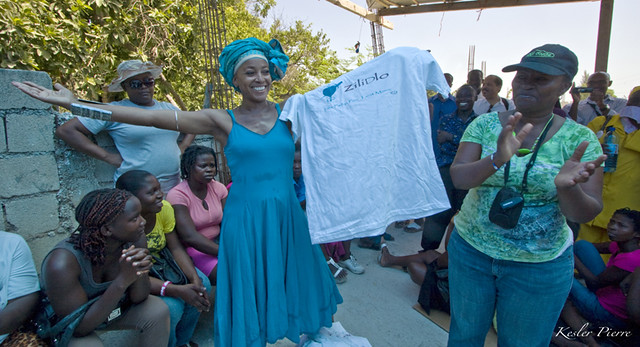
Ezili Dantò, Rea Dol and the Zili Dlo beneficiaries, August 10, 2011 |Photo credit: Kesler Pierre, HLLN

Ezili Dantò speaking with Cuban doctor at Mirebalais hospital about the UN-imported cholera epidemic in Haiti and first cases diagnosed by Cuban doctors at the Mirebalais hospital, Oct. 2010. Photo credit: Jean Ristil Jean Baptise for HLLN
Make a donation to support Ezili’s HLLN clean water project

Human Rights lawyer Ezili Dantò is dedicated to correcting the media lies and colonial narratives about Haiti. A writer, performance poet and lawyer, Ezili Dantò is founder and president of the Haitian Lawyers Leadership Network (HLLN). For updates, join the Ezili HLLN’s Listserve. Learn more at the website .
Donate to this work

Donate to this work
*********************************
BACKGROUND INFORMATION
*********************************
Video: Alternative Pour Haiti Energie Solaire
*********************************
The women bringing solar power to Sierra Leone
An Indian college has trained 12 Sierra Leonean women to become solar engineers as part of a drive to bring electricity to rural communities
Source: The Guardian
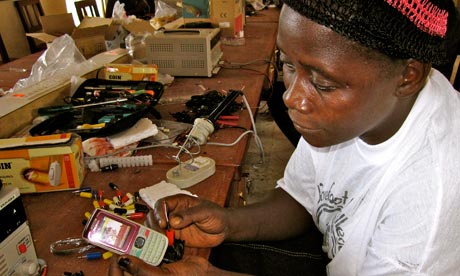
A group of 12 women from villages in Sierra Leone is in the frontline of a battle to bring solar-powered electricity to rural communities. No small feat, given that rural Sierra Leone is not connected to power.
The women were all trained at Barefoot College in Tilonia, Rajasthan, in western India. They are now back in Sierra Leone assembling 1,500 household solar units at a new Barefoot College in Konta Line village, Port Loko district, which is to be formally opened next month. They sit at long wooden tables fitting tiny coloured resisters to circuit boards – heads tilted, deep in concentration, as smoke puffs up from their soldering irons.
The women are all either illiterate or semi-literate – they used to be subsistence farmers, living day-to-day like millions in Sierra Leone. But now they are proud graduates, having travelled 6,000 miles to India to learn – in the women’s words – “how to make light from the sun”.
“The idea of solar was so surprising that I had to be a part of it,” says Mary Dawo from Romakeneh village.
“Snakes, rodents, reptiles and biting insects crept and crawled into our homes with the dark at 7pm. Children couldn’t study, and we couldn’t relax, socialise or plan our lives after a long day’s work,” says Fatmata Koroma from Mambioma village.
The Barefoot College in Sierra Leone is the first in Africa. It will enrol up to 50 students on four-month residential courses in solar engineering. The Sierra Leone government has invested about $820,000 in the project. Though the college is funded by the government, the women hope they can run it independently, in what they describe as the “Barefoot way”. The solar equipment the college runs on, and the equipment for 10 villages, was provided by the Barefoot College in India, and the initial training was sponsored by the Indian government as part of its south-south co-operation programme.
“In India, the first problem was vegetarian food,” says Koroma. “The desert was too hot and everything was different. But, within months we could assemble circuits and construct systems. Anything was possible after that.”
The graduates now live in the college hostel, where they will stay until they have trained their replacements “for the service to our villages and our country”, says Nancy Kanu. She was in the first female batch of students to train in India, in 2007, the same year that Konta Line village, where she’s from, was declared the first solar village. She is now chief solar engineer. “Iteach full-time, but I’m on call – even at night – to fix a fuse, change a bulb or charge a phone,” she says.
People interact differently now in Konta Line, says Aminata Kargbo. “People socialise more – they’re nicer,” she says. The advent of solar energy has saved the village about $1,000 in candles and kerosene so far; money that is being kept for the upkeep of solar equipment.
However, the solar units are expensive [$500-$800] and far beyond the reach of most rural households. “There’s a 45% import tax ”¦ You need electricity to manufacture solar equipment here,” says Idriss Kamara of the Safer Future Youth Development Project. The local NGO tackles the country’s 60% youth unemployment, training people in vocational skills, including solar. But, Kamara says, few solar trainees find work because hardly any households use it. The government says it is looking to reduce the tax so benefits are passed on to customers and access to solar power increases.
However, while Sierra Leone’s government supports the Barefoot College project, people have wider energy needs, says Yvette Stevens of the ministry of energy and water. “We are developing a broader rural energy programme focusing on community, productive and social needs,” she says. Renewables such as solar, biofuels and hydro form the basis of this programme, supported by an upcoming World Bank project. “There’s a lot of donor money for renewables now, given their impact on climate change,” says Stevens. The government envisages local solar systems will provide power for clinics and schools, and for “water pumps, communal television, and computer centres”, she explains. Energy is not set out as a separate MDG, but it’s vital in meeting them, she says.
Sierra Leone is still catching up after the lost years of the decade-long civil war that wiped out the country’s fragile infrastructure. More than 60% of people (about 3.6 million) live rurally. Few can afford generators. Even in urban areas, more than 90% of people go without power.
A recent World Bank report states that electricity is Sierra Leone’s most daunting infrastructure challenge. This, despite the new Bumbuna hydropower plant, which has improved the situation in the capital, Freetown, a little during the rainy season, providing nearly half the city’s demand. Nevertheless, rural areas lag far behind. Sierra Leone records 46 days of power outages a year, which is four times higher than in other low-income African states.
They may be a small part of a bigger strategy, but Sierra Leone’s Barefoot women are thinking about the future. “Once these units are installed, Ithink we’ll need an investor to manufacture solar units here to make them affordable for everyone,” Barefoot College graduate Kanu says. “There’s nothing we can’t learn now to make our lives better. We have the power to change our villages.”
**********************
Beyond Fossil Fuels
African Huts Far From the Grid Glow With Renewable Power

Thanks to this solar panel, Sara Ruto no longer takes a three-hour taxi ride to a town with electricity to recharge her cellphone. More Photos »
by Elisabeth Rosenthal, Dec. 24, 2010, Source: New York Times
KIPTUSURI, Kenya — For Sara Ruto, the desperate yearning for electricity began last year with the purchase of her first cellphone, a lifeline for receiving small money transfers, contacting relatives in the city or checking chicken prices at the nearest market.
Charging the phone was no simple matter in this farming village far from Kenya’s electric grid.
Every week, Ms. Ruto walked two miles to hire a motorcycle taxi for the three-hour ride to Mogotio, the nearest town with electricity. There, she dropped off her cellphone at a store that recharges phones for 30 cents. Yet the service was in such demand that she had to leave it behind for three full days before returning.
That wearying routine ended in February when the family sold some animals to buy a small Chinese-made solar power system for about $80. Now balanced precariously atop their tin roof, a lone solar panel provides enough electricity to charge the phone and run four bright overhead lights with switches.
“My main motivation was the phone, but this has changed so many other things,” Ms. Ruto said on a recent evening as she relaxed on a bench in the mud-walled shack she shares with her husband and six children.
As small-scale renewable energy becomes cheaper, more reliable and more efficient, it is providing the first drops of modern power to people who live far from slow-growing electricity grids and fuel pipelines in developing countries. Although dwarfed by the big renewable energy projects that many industrialized countries are embracing to rein in greenhouse gas emissions, these tiny systems are playing an epic, transformative role.
Since Ms. Ruto hooked up the system, her teenagers” grades have improved because they have light for studying. The toddlers no longer risk burns from the smoky kerosene lamp. And each month, she saves $15 in kerosene and battery costs — and the $20 she used to spend on travel.
In fact, neighbors now pay her 20 cents to charge their phones, although that business may soon evaporate: 63 families in Kiptusuri have recently installed their own solar power systems.
“You leapfrog over the need for fixed lines,” said Adam Kendall, head of the sub-Saharan Africa power practice for McKinsey & Company, the global consulting firm. “Renewable energy becomes more and more important in less and less developed markets.”
The United Nations estimates that 1.5 billion people across the globe still live without electricity, including 85 percent of Kenyans, and that three billion still cook and heat with primitive fuels like wood or charcoal.
There is no reliable data on the spread of off-grid renewable energy on a small scale, in part because the projects are often installed by individuals or tiny nongovernmental organizations.
But Dana Younger, senior renewable energy adviser at the International Finance Corporation, the World Bank Group’s private lending arm, said there was no question that the trend was accelerating. “It’s a phenomenon that’s sweeping the world; a huge number of these systems are being installed,” Mr. Younger said.
With the advent of cheap solar panels and high-efficiency LED lights, which can light a room with just 4 watts of power instead of 60, these small solar systems now deliver useful electricity at a price that even the poor can afford, he noted. “You’re seeing herders in Inner Mongolia with solar cells on top of their yurts,” Mr. Younger said.
In Africa, nascent markets for the systems have sprung up in Ethiopia, Uganda, Malawi and Ghana as well as in Kenya, said Francis Hillman, an energy entrepreneur who recently shifted his Eritrea-based business, Phaesun Asmara, from large solar projects financed by nongovernmental organizations to a greater emphasis on tiny rooftop systems.
In addition to these small solar projects, renewable energy technologies designed for the poor include simple subterranean biogas chambers that make fuel and electricity from the manure of a few cows, and “mini” hydroelectric dams that can harness the power of a local river for an entire village.
Yet while these off-grid systems have proved their worth, the lack of an effective distribution network or a reliable way of financing the start-up costs has prevented them from becoming more widespread.
“The big problem for us now is there is no business model yet,” said John Maina, executive coordinator of Sustainable Community Development Services, or Scode, a nongovernmental organization based in Nakuru, Kenya, that is devoted to bringing power to rural areas.
Just a few years ago, Mr. Maina said, “solar lights” were merely basic lanterns, dim and unreliable.
“Finally, these products exist, people are asking for them and are willing to pay,” he said. “But we can”t get supply.” He said small African organizations like his do not have the purchasing power or connections to place bulk orders themselves from distant manufacturers, forcing them to scramble for items each time a shipment happens to come into the country.
Part of the problem is that the new systems buck the traditional mold, in which power is generated by a very small number of huge government-owned companies that gradually extend the grid into rural areas. Investors are reluctant to pour money into products that serve a dispersed market of poor rural consumers because they see the risk as too high.
“There are many small islands of success, but they need to go to scale,” said Minoru Takada, chief of the United Nations Development Program’s sustainable energy program. “Off-grid is the answer for the poor. But people who control funding need to see this as a viable option.”
Even United Nations programs and United States government funds that promote climate-friendly energy in developing countries hew to large projects like giant wind farms or industrial-scale solar plants that feed into the grid. A $300 million solar project is much easier to finance and monitor than 10 million home-scale solar systems in mud huts spread across a continent.
As a result, money does not flow to the poorest areas. Of the $162 billion invested in renewable energy last year, according to the United Nations, experts estimate that $44 billion was spent in China, India and Brazil collectively, and $7.5 billion in the many poorer countries.
Only 6 to 7 percent of solar panels are manufactured to produce electricity that does not feed into the grid; that includes systems like Ms. Ruto’s and solar panels that light American parking lots and football stadiums.
Still, some new models are emerging. Husk Power Systems, a young company supported by a mix of private investment and nonprofit funds, has built 60 village power plants in rural India that make electricity from rice husks for 250 hamlets since 2007.
In Nepal and Indonesia, the United Nations Development Program has helped finance the construction of very small hydroelectric plants that have brought electricity to remote mountain communities. Morocco provides subsidized solar home systems at a cost of $100 each to remote rural areas where expanding the national grid is not cost-effective.
What has most surprised some experts in the field is the recent emergence of a true market in Africa for home-scale renewable energy and for appliances that consume less energy. As the cost of reliable equipment decreases, families have proved ever more willing to buy it by selling a goat or borrowing money from a relative overseas, for example.
The explosion of cellphone use in rural Africa has been an enormous motivating factor. Because rural regions of many African countries lack banks, the cellphone has been embraced as a tool for commercial transactions as well as personal communications, adding an incentive to electrify for the sake of recharging.
M-Pesa, Kenya’s largest mobile phone money transfer service, handles an annual cash flow equivalent to more than 10 percent of the country’s gross domestic product, most in tiny transactions that rarely exceed $20.
The cheap renewable energy systems also allow the rural poor to save money on candles, charcoal, batteries, wood and kerosene. “So there is an ability to pay and a willingness to pay,” said Mr. Younger of the International Finance Corporation.
In another Kenyan village, Lochorai, Alice Wangui, 45, and Agnes Mwaforo, 35, formerly subsistence farmers, now operate a booming business selling and installing energy-efficient wood-burning cooking stoves made of clay and metal for a cost of $5. Wearing matching bright orange tops and skirts, they walk down rutted dirt paths with cellphones ever at their ears, edging past goats and dogs to visit customers and to calm those on the waiting list.
Hunched over her new stove as she stirred a stew of potatoes and beans, Naomi Muriuki, 58, volunteered that the appliance had more than halved her use of firewood. Wood has become harder to find and expensive to buy as the government tries to limit deforestation, she added.
In Tumsifu, a slightly more prosperous village of dairy farmers, Virginia Wairimu, 35, is benefiting from an underground tank in which the manure from her three cows is converted to biogas, which is then pumped through a rubber tube to a gas burner.
“I can just get up and make breakfast,” Ms. Wairimu said. The system was financed with a $400 loan from a demonstration project that has since expired.
In Kiptusuri, the Firefly LED system purchased by Ms. Ruto is this year’s must-have item. The smallest one, which costs $12, consists of a solar panel that can be placed in a window or on a roof and is connected to a desk lamp and a phone charger. Slightly larger units can run radios and black-and-white television sets.
Of course, such systems cannot compare with a grid connection in the industrialized world. A week of rain can mean no lights. And items like refrigerators need more, and more consistent, power than a panel provides.
Still, in Kenya, even grid-based electricity is intermittent and expensive: families must pay more than $350 just to have their homes hooked up.
“With this system, you get a real light for what you spend on kerosene in a few months,” said Mr. Maina, of Sustainable Community Development Services. “When you can light your home and charge your phone, that is very valuable.”
******
Add a comment:
Powered by Facebook Comments